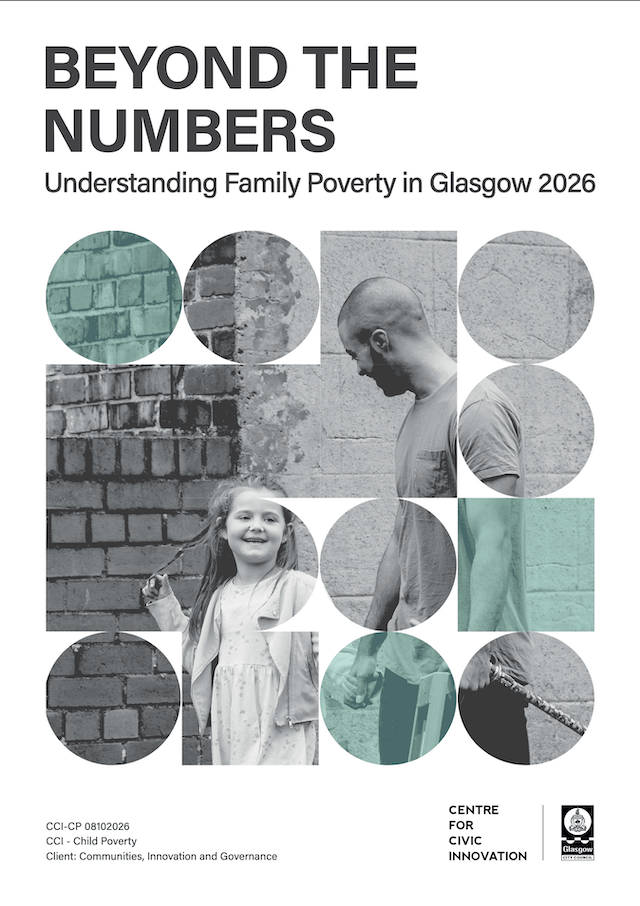
Understanding Family Poverty in Glasgow 2026
This is our seventh annual publication providing a detailed overview of family poverty in Glasgow.
Poverty remains Glasgow's most significant challenge. It is a cause and consequence of the wider inequalities affecting not only individuals, also the strength, cohesion and resilience of communities.
As well as providing as providing statistical insight into family poverty, we go beyond the numbers, combining data analysis with lived experience and service expertise to provide insight that can guide decision making and help focus our collective effort to support families and communities to flourish.
View our dashboard
The Child Poverty Dashboard is a partner tool to the Centre for Civic Innovation's Child Poverty Report. It makes the data that we use to measure child poverty in the city publicly available and allows anyone to scrutinise the data we have produced.
Our aim is to provide Council Officers, and groups with an interest in reducing Child Poverty, with the knowledge to make decisions, design services and drive policy.
What's in this edition
A look at poverty in motion
We explore some of the reasons families move in and out of poverty throughout the year.
Scottish Government's Priority Groups
We provide a statisical insight into the groups that are disproportionately affected by child poverty.
Families as our greatest asset
We go beyond the numbers to examine what we learned about the foundations of family life.
Glasgow's strategic priority
Reducing family poverty is at the heart of the work of the Glasgow Community Planning Partnership, embedded in Glasgow City Council’s Strategic Plan and reflected in national commitments set out by the Scottish Government.
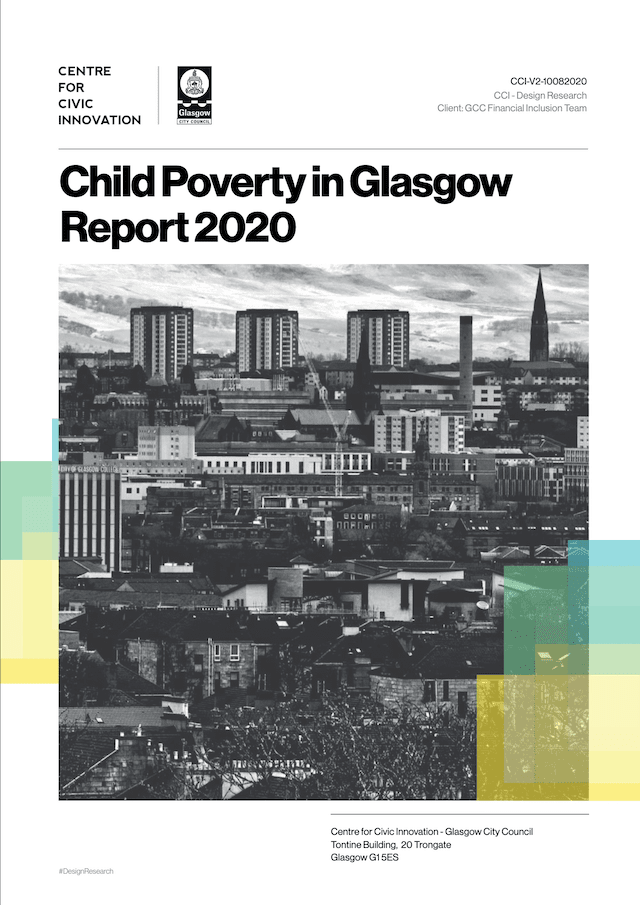
We're now on our seventh iteration of the report. In partnership with the Financial Inclusion Team, the CCI wrote the first Child Poverty in Glasgow Report for 2019/2020, Having reported on the level of child poverty in the city since before the pandemic, we have a clear baseline which allows them to compare to pre-pandemic levels of family income and poverty.